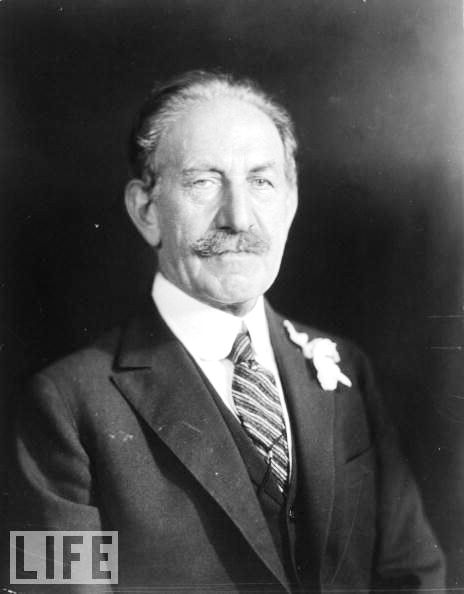
SAMUEL UNTERMYER
A man for all seasons.
Samuel Untermyer was born in Virginia in 1858, and moved to New York City after the Civil War. He was a partner in the law firm of Guggenheimer, Untermyer & Marshall, and was the first lawyer in America to earn a one million dollar fee on a single case. He was also an astute investor, and became extremely wealthy.
Initially he was a corporate lawyer, but later in his career he became a trust-buster. He was instrumental in the establishment of the Federal Reserve System, advocated for the regulation of stock exchanges and other legal reforms. He was an influential Democrat and a close ally of Woodrow Wilson.
Samuel Untermyer was one of the most prominent Jews of his day in America. He was a prominent Zionist, and was President of the Keren Hayesod. In addition, he was the national leader of an unsuccessful movement in the early 1930s for a worldwide boycott of Germany, and called for the destruction of Hitlers regime.
His wife, Minnie Untermyer, was at the center of cultural circles in New York City. She was one of two women who transformed the New York Philharmonic in 1909, and brought Gustav Mahler to conduct the orchestra. She was also President of the American Poetry Society, and a patroness of artists and dancers in New York.
Samuel Untermyer was also passionately interested in horticulture. He famously said that if he could do it over again, he would want to be the Parks Commissioner in New York City! Unlike most wealthy garden-owners, Untermyer was expertly knowledgable about gardening. The level of connoisseurship at the Untermyer Gardens was nationally famous, and many great gardeners got their training there. He often sent an agent to recruit English gardeners on ships arriving in New York harbor.
His ambition for the garden was that it be not less than the finest garden in the world.*
--------------------------------------------------------------------------------------------------------------------
* Â Letter, William Welles Bosworth to John D. Rockefeller, Jr., Rockefeller Archive Center
Samuel Untermyer
Articles of Interest
Samuel Untermyer In His Enchanted Garden; Written by Gove Hambridge in Better Homes and Gardens,  January, 1928
"Hitler's Bitterest Foe": Â Samuel Untermyer and the Boycott of Nazi Germany 1933 to 1938; Richard A. Hawkins;Â American Jewish History, March 1, 2007

COME JOIN US ON OUR NEXT TOUR